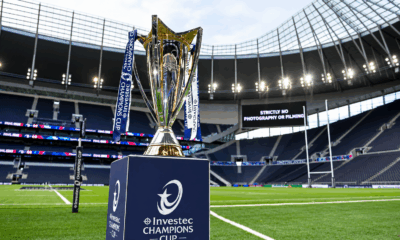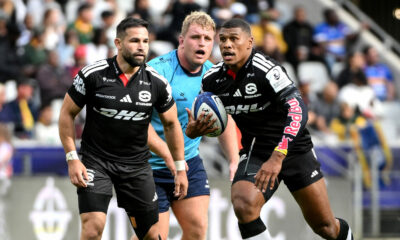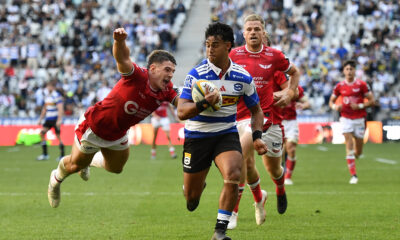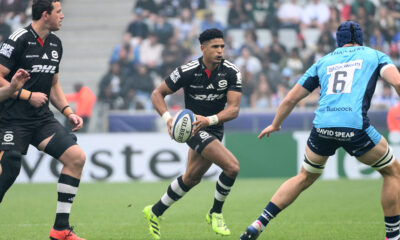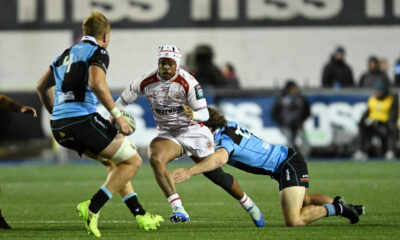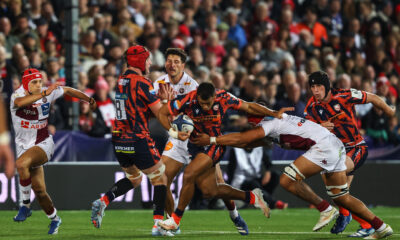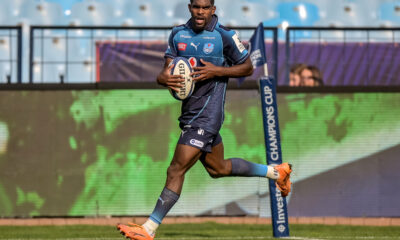
Results for the finals of World Rugby U20 Championship matches (via Sport24)
France claimed a 33-25 Final victory over England, inspired by the boot of flyhalf Louis Carbonel, who contributed 23 points to the side. The Baby Boks fought back from trailing 25-14 to the Baby Blacks at half time to win 40-30 and claim 3rd place at the World Rugby U20 Championship
Papier in power performance as Bulls charge in URC
Bulls No 9 Embrose Papier responded to his omission from the Springboks alignment camp in the best possible way, with another Player of the Match performance in the URC.
Papier was proper in the Bulls 40-7 win against Cardiff in the URC at Loftus, Pretoria, having been a late withdrawal a week ago against the Stormers a week ago.
The Bulls lost to the Stormers and Papier’s absence was obvious.
Against Cardiff he was at the heart of everything good about the Bulls attack, was individually decisive and composed, produced consistency in his kicking game management, electric pace for his try and was always a threat on the break, especially close to the fringes of the ruck.
Rassie Erasmus picked Papier for the Springboks in 2018, but it has been seven long years in-between drinks for the Bulls No 9.
In this time Erasmus, coach in 2018, Jacques Nienaber, coached between 2020 and 2023 and Erasmus, back as head coach from 2024, have relied on Faf de Klerk, Herschel Jantjies andCobus Reinachto win the 2019 RWC and on De Klerk, Reinach, Grant Williams and Jaden Hendrikse to win the 2023 RWC.
Nienaber and Erasmus (National Director of Rugby) picked all four No 9s in the match 23 that beat Romania 76-0 at the World Cup. Reinach started at No 9, Williams started on the right wing and Hendrikse was the reserve No 9 and De Klerk the reserve No 10 and goalkicker.
In the 2024 and 2025 Test seasons, Lions No 9 Morné van den Bergplayed Test rugby and in Erasmus’s first Springboks alignment camp for 2025, earlier in March, SA under 20 World Championship winner Haashim Pead was included in a group of No 9s, while De Klerk and Jantjies were among the overseas-based players selected for a virtual alignment camp.
De Klerk, who spent a lengthy time on the sidelines because of injury, found form in scoring three tries for the Yokohama Canon Eagles’ 38-29 win against Dave Rennie’s Japanese League 1 log-leading Kobelco Kobe Steelers. He was named Player of the Match.
Jantjies has started nine of 15 matches for French Top 14 club Bayonne.
De Klerk has signed to return to South Africa and play for the Cheetahs after five seasons in Japan. Before Japan he played for Sale Sharks in Manchester, England, having made his Test debut when playing for the Johannesburg-based Lions.
In 2018 the then Bulls No 9 Ivan van Zyl and Lions No 9 Ross Cronje were also selected for the Boks.
Papier, a Bulls Centurion, has started 10 of 14 matches for the club this season, 11 in the United Rugby Championship and three in the Investec Champions Cup, and has scored six tries.
Papier made his Test debut in 2018. He has not played for the Boks again since 2018.
He is still just 28 years-old
SH Rugby Blog, back in 2018, asked if Papier was not trusted by Erasmus, given the minimal game time.
List of games in which Papier was in the Match Day 23, and his minutes played
Date
Opponent
Detail
June 2, 2018
Wales
4 minutes at wing, Washington DC (Springbok debut)
June 2018
England
Not in matchday 23 for first two Tests
June 23, 2018
England
5 minutes at scrumhalf, Cape Town (3rd Test)
August 18, 2018
Argentina
7 minutes at wing, Durban
August 25, 2018
Argentina
Unused substitute, Mendoza
September 8, 2018
Australia
Unused substitute, Brisbane
September 15, 2018
New Zealand
Replaced in matchday 23 by Ross Cronjé (unused), Wellington
September 29, 2018
Australia
Unused substitute, Port Elizabeth
October 6, 2018
New Zealand
7 minutes at scrumhalf, Pretoria
November 3, 2018
England
6 minutes at scrumhalf, London
November 2018
France
Not in matchday 23
Papier, on the 17th November, 2018, finally got to start against Scotland at Murrayfield and played for 78 minutes. The Boks won 26-20, with Handre Pollard scoring 18 points and Elton Jantjies kicking a late penalty to secure the win. Of the Boks match 23 of that day, 19 went onto win the World Cup, left winger Aphiwe Dyantyi was banned for testing positive, right winger Sbu Nkosi lost form and his appetite for rugby, beset by off-field disciplinary issues, Van Zyl found a future at Saracens in the English Premiership and Papier was sent back to the Bulls.
South Africa: Willie le Roux, Sbu Nkosi, Jesse Kriel, Damian de Allende, Aphiwe Dyantyi, Handre Pollard, Embrose Papier; Steven Kitshoff, Malcolm Marx, Frans Malherbe, RG Snyman, Franco Mostert, Siya Kolisi (captain), Pieter-Steph du Toit, Duane Vermeulen.
Replacements: Bongi Mbonambi (for Marx, 66), Thomas du Toit (for Kitshoff, 58), Vincent Koch (for Malherbe, 58), Lood de Jager (for Snyman, 60), Francois Louw (for Kolisi, 66), Ivan van Zyl (for Papier, 78), Elton Jantjies (for De Allende, 56), Cheslin Kolbe (for Nkosi, 64).
In the 2026 Six Nations, France winger Louis Bielle-Biarrey owned the stats charts. Nine tries, four assists and a presence across ten statistical categories tell the real story of France’s title.
The Six Nations2026 stats sheet was owned by France’s magnificent left winger Louis Bielle-Biarrey, with teammate Thomas Ramos the best of the many support acts within the squad that won the Six Nations title.
Ramos, without comparison off the kicking tee, kicked a penalty after the final buzzer, to beat England 48-46 in Paris, and ensure France were not denied a second successive Six Nations title.
Photo: David Rogers/Getty Images
The win was France’s 10th European title (Five Nations/Six Nations) in the last 30 years.
France’s Five and Six Nations titles since professionalism began in 1996
Year
Competition
Title type
1997
Five Nations
Winners
1998
Five Nations
Grand Slam
2002
Six Nations
Grand Slam
2004
Six Nations
Grand Slam
2006
Six Nations
Winners
2007
Six Nations
Winners
2010
Six Nations
Grand Slam
2022
Six Nations
Grand Slam
2025
Six Nations
Winners
2026
Six Nations
Winners
*Grand Slam indicates an unbeaten tournament.
Six Nations 2026 stats
Bielle-Biarrey’s nine tournament tries in 2026 is a record, and he is the first player to score in every match in two successive Six Nations campaigns. He has 18 Six Nations tries in 14 matches, with retired Ireland centre Brian O’Driscoll’s Six Nations record of 26 tries having come in 65 matches.
His strike rate is unmatched at Test level, with 29 tries from 27 Test matches.
Bielle-Biarrey, supreme as a try-scoring finisher, was everywhere the game lived.
Top of the try charts. Among the leaders for metres made. Present in try assists. Leading initial breaks. High in metres per carry. Involved in attacking catch success. Even appearing in the kicking metrics.
Bielle-Biarrey, who played every minute of the Six Nations, featured in 10 categories.
His back three teammate Ramos was as good, in a different way. Ramos featured in eight categories: Carries, metres, offloads, assists and, crucially, points. Ramos missed just four kicks at posts in 32, for an 88% return. He was also the tournament’s leading points scorer and one of the busiest players on attack.
France No 10 Matthieu Jalibert, who played four of the five matches, was top of the offloads, try assist and in the top bracket for defenders beaten. Add in his kicking influence, in tandem with captain and scrum half Antoine Dupont, and Jalibert is prominent in seven categories.
If France owned the attacking narrative, Ireland’sNo 12Stuart McCloskey owned the gainline. Seven categories tell the story: carries, offloads, assists, defenders beaten, dominant contact, post-contact metres and turnovers. There was no cleaner or more complete midfield presence in the tournament. Every carry broke the initial wall and every collision advanced Ireland’s attack.
The little generals in Dupont and Wales’s Tomos Williams don’t dominate tries, but they dominate territory. Kicks in play, kick metres, box kicks, retained kicks meant both No 9s are leading contributors in six categories.
Italy’s mighty midfielder Tommaso Menoncello has a presence in six categories: Metres made. Defenders beaten. Initial breaks. Turnovers, Jakkals and Metres per carry. He was as consistent in his defence and attack and his Six Nations will be remembered for the try and try assist in Italy’s historic first win against England in Rome in Round 4.
England’s Ben Earl is the forward outlier. Leading carries. Leading post-contact metres. Dominant in contact. A four-category presence in a game that increasingly separates roles. He is the closest England has to a proper hybrid international player. Earl, best at No 8, can also play in the midfield.
Scotland’s versatile winger and Glasgow Warriors captain Kyle Steyn. The South African born former Stellenbosch University and Griquas star was a standout in defenders beaten, top tier in metres made and elite in metres per carry. Steyn enjoyed his most influential tournament, and was strong in Scotland’s wins against England and France at Murrayfield in Edinburgh.
South African schools rugby is the foundation of the Springboks, with historic derbies like Paarl Boys High vs Paarl Gimnasium showcasing the intensity, tradition and talent pipeline that defines the game.
The road to 100 Springbok Test caps does not start with a professional contract. It starts at SA Schools Rugby and South Africa is blessed to have among the most powerful rugby-centric schooling institutions. The result is nine Test Centurions and four RWC titles and two third place finishes in eight tournaments since the Springboks won the 1995 World Cup on their first attempt.
SA Schools Rugby
South African rugby starts on school fields in Paarl, Newlands, Durbanville, Stellenbosch, Bloemfontein, Johannesburg, Durban and Cape Town, where reputations are made long before players earn contracts, caps or salaries.
This is where the edge is built, with rivalries more than 100 years old. This is where the journey of the greatest Springboks began and it is the playground of future Springboks and South Africa’s professional rugby elite.
Photo: Paul Kane/Gallo Images
The scale of the system is unmatched globally: structured leagues, nationally broadcast derbies, Easter festivals that act as early-season measuring sticks, and the annual Coca-Cola Craven Week, which remains the definitive pathway into SA Schools selection.
The Premier Schools: The heavyweights of South African rugby.
There is no officially sanctioned national ranking body in South African schools rugby. However, multiple independent platforms compile results-based rankings using fixtures, strength of schedule and head-to-head outcomes.
The most widely referenced is NextGenXV, whose final 2025 rankings are also incorporated into broader consensus rankings by platforms such as SchoolboyRugby (which combines data from NextGenXV, SA School Sports and Rugby365).
Top 20 Schools (Results-based – 2025 Final Ranking)
Rank
School
1
Paarl Boys’ High
2
Paarl Gimnasium
3
Grey College
4
Affies
5
Oakdale Landbou
6
Westville
7
Paul Roos Gymnasium
8
DHS
9
Garsfontein
10
Rondebosch
11
Helpmekaar
12
Outeniqua
13
Hilton College
14
Wynberg
15
Stellenberg
16
Menlopark
17
Northwood
18
Noordheuwel
19
Boland Landbou
20
Queen’s College
The Western Cape dominates the depth conversation. Free State has Grey College and the Eastern Cape has heritage. Gauteng and KZN bring muscle, but no province matches the Western Cape for weekly jeopardy and top-20 spread.
Western Province: The Deepest Schools League in the Country
On a single WP Schools Day card in 2026, you get: Paarl Boys, Paarl Gim, Paul Roos, SACS, Bishops, Rondebosch, Wynberg, Boland Landbou, Durbanville and Stellenberg.
In the 2025 Top 20 rankings, the Western Cape placed eight schools in the top tier, including Paarl Boys, Paarl Gim, Oakdale, Paul Roos, Rondebosch and Wynberg.
No province produces pressure like this and no province produces Springboks like this. It is borne out by how Western Province dominated the annual Coca Cola Craven Week.
FNB Classic Clashes & King Price Derby Series
South African schoolboy rugby attracts some of the biggest sponsors, with FNB having the longest association with Schools Rugby. The additional exposure, through SuperSport’s live coverage of Schools 1st XV matches has added to the value of commercial alignment with Schools rugby.
The SuperSport Schools app has exceeded one million downloads.
The FNB Classic Clashes, launched in the early 2000s, grew from 10 fixtures to more than 50 nationwide, becoming a cornerstone of school rugby broadcasting on SuperSport Schools.
Today, the King Price Derby Series carries that torch, packaging the biggest rivalries into a national viewing product built on history, tribalism and crowd energy.
This is where schoolboy rugby becomes appointment viewing.
The Springboks 2026 alignment camp is, by definition, Rassie Erasmus naming his best 70 players. That is the starting point for any analysis, and it is why the omission of Juarno Augustus is the story.
He forced his way into the 2025 alignment camp on the back of consistent performances in Europe, carrying with authority and playing with the kind of physical edge that traditionally translates to Springbok rugby. His inclusion suggested momentum and acknowledgement from Erasmus that the player, formerly of the Stormers, had moved from the periphery into genuine national contention.
Augustus made the on-field statement playing for Northampton Saints, but never made it to the Springboks camp because he had not passed a transfer medical to Ulster at the time.
Post this injury-enforced failed medical, Augustus moved to Ulster and has been a strong influence when fit. He had been on the sidelines in early 2026 but showed no rust in dominating the collisions as Ulster beat Edinburgh in the United Rugby Championship last weekend.
Augustus, in the 2025/26 season, has started seven of nine matches for Ulster, with an average playing time of 54 minutes. He has played seven URC matches and two EPCR Challenge Cup matches.
In 2024/25, he started 15 of Northampton’s 19 matches, averaged 56 minutes a game, went past 1000 on-field minutes and was a star performer as the Saints marched toward the Investec Champions Cup final. Augustus missed the losing final against Bordeaux because of injury, but was fabulous in the semi-final win against Leinster at the Aviva Stadium in Dublin.
Less than a year ago, Augustus, a former Junior Springboks Player of the Year, was a headline for all the right reasons. This week, his omission is the headline, given just a few days ago he was named Player of the Match
It does not seem like a minor selection call from Erasmus.
In a system where the alignment camp reflects the coach’s thinking and pretty much his strongest available player pool, absence is definitive. Augustus has not been managed out. On the surface he has been left out, and the distinction matters. It tells you that, right now, he is not viewed as one of the leading options at No 8 or within the broader loose forward mix.
And that is where the context becomes important.
The Springboks are not short on depth in the back row. Established internationals remain in the system, while younger players have been backed through consistent exposure and selection. The competition among No 8 options is intense and Erasmus never selects on sentiment or for the sake of a good news story.
What is perplexing is what has changed regarding Augustus because his on-field performances remain as imposing as they did a year ago.
Erasmus has omitted players from alignment camps previously and picked them to play Test rugby that season.
The exclusion, this week when Erasmus named a virtual alignment camp group of overseas-based South African players eligible for the Boks, does not mean the door is locked, but it certainly doesn’t promise an easy way back in when the reality is that Erasmus has invited 70 players to his two respective camps, 49 for the early March camp in Cape Town, and a further 21 for the virtual camp.
Six players drop out of the Springboks 2026 alignment camp from 2025, but it is the absence of Augustus that defines the shift – from bolter to outside the Bok top 70.
2025 vs 2026 – Players OUT
Forwards omitted (2025 → not in 2026)
Player
Position
2025 Status
2026 Status
Note
Juarno Augustus
No 8
Virtual camp (overseas)
❌ Omitted
Biggest omission
Vincent Koch
Prop
Local camp
❌ Omitted
Senior tighthead depth
Bongi Mbonambi
Hooker
Local camp
❌ Omitted
Double RWC winner
Renzo du Plessis
Loose forward
Local camp
❌ Omitted
Uncapped Test player
Backs omitted (2025 → not in 2026)
Player
Position
2025 Status
2026 Status
Note
Willie le Roux
Fullback
Local camp
❌ Omitted
Double World Cup winner
Ntokozo Makhaza
Wing
Local camp
❌ Omitted
Varsity Cup standout
Springbok fixtures 2026:
International: Saturday 20 June: Springboks v Barbarians (Nelson Mandela Bay Stadium, Gqeberha) – TICKETS
Nations Championship: Saturday 4 July: Springboks v England (Ellis Park, Johannesburg)
Saturday 11 July: Springboks v Scotland (Loftus Versfeld, Pretoria)
Saturday 18 July: Springboks v Wales (Hollywoodbets Kings Park, Durban)
Rugby’s Greatest Rivalry: Saturday 22 August: Springboks v All Blacks (Ellis Park, Johannesburg)
Saturday 29 August: Springboks v All Blacks (DHL Stadium, Cape Town)
Saturday 5 September: Springboks v All Blacks (FNB Stadium, Johannesburg)
Saturday 12 September: Springboks v All Blacks (M&T Bank Stadium, Baltimore, USA) For available RGR tickets in SA, CLICK HERE
Once-off Tests: Saturday, 8 August: Argentina v Springboks (venue TBC)
Sunday 27 September: Wallabies v Springboks (Optus Stadium, Perth)
Nations Championship: Saturday 7 November: Italy v Springboks (venue TBC)
Friday 13 November: France v Springboks (Stade de France, Paris)
Saturday 21 November: Ireland v Springboks (Aviva Stadium, Dublin)
Friday 27 to Sunday 29 November: Finals Weekend (Allianz Stadium, Twickenham, London) –SOURCE
United Rugby Championship: South Africa’s rugby powerhouse
South Africa has redefined the United Rugby Championship since 2021, turning a northern league into a cross-continental powerhouse driven by Stormers flair, Bulls consistency and relentless Springbok influence.
The United Rugby Championship was never meant to belong to South Africa, but in many respects it now does.
The United Rugby Championship shifted rugby’s power
South Africa has redefined the United Rugby Championship since 2021, turning a northern league into a cross-continental powerhouse driven by Stormers flair, Bulls consistency and relentless Springbok influence. From four finals in four seasons to hosting the first three deciders, the United Rugby Championship South Africa story is one of immediate impact, growing dominance and a competition that now runs through Cape Town and Pretoria as much as Dublin.
It is an evolution of the Pro 12, which was a northern hemisphere competition, built on Celtic identity, Irish excellence, Welsh tradition, Italian innovation and Scottish swagger. It had history, rivalry and relevance but it did not have the the presence of South Africa, the breeding ground of World Cup winning Springboks.
When South Africa arrived in the newly formed 16-team United Rugby Championship, it reshaped the league.
Four seasons into the URC era a South African franchise has featured in every single final. The country hosted the first three deciders. Two of those finals were in Cape Town and one was in Pretoria.
From Celtic comfort to cross-continental combat
The league started life in 2001 as the Celtic League, a tight, regional competition. Then came evolution: Italy joined and it became the PRO12 and then the PRO14, with the South Africa’s Cheetahs and Kings more of an exercise in flirtation than finality.
The reset came in 2021, with the league played behind mostly with Covid restrictions.
The South African quartet, plus their Pro 14 predecessors the Cheetahs and Kings, had played in Super Rugby since 1996, and while South Africa’s decision to go north was deemed controversial by some, most in South Africa acknowledged the value of playing in the northern hemisphere.
What was once a northern league is now rugby’s most compelling cross-continental competition.
Different climates. Different tempos. Different rugby identities.
South Africa’s imprint: Immediate, Physical, Decisive
South Africa didn’t need time to adjust, as borne out by the first four finals.
The 2007 Rugby World Cup-winning Springboks coach Jake White guided the Bulls to three finals in four years and the Stormers, under John Dobson, own South Africa’s most significant chapter, winning the inaugural URC season in beating the Bulls 18-13.
Dobson’s Stormers: The blueprint of URC success
Dobson’s Stormers play with instinct, speed and counter-attack but beneath it sits structure and belief. Western Province school rugby pipelines feeding a professional system that trusts its talent.
At home, at the DHL Stadium in Cape Town, they are difficult to beat.
And in doing so, they’ve defined what URC rugby can look like when South African skill meets South African confidence.
The Bulls: Power, altitude and unfinished business
If the Stormers are all about expression, then the Bulls are about power and pressure.
Loftus Versfeld, in Pretoria, remains one of the toughest assignments in club rugby, with the altitude and the attitude of the hosts often a tonic for opposition scoreboard strain.
White did a fine job in getting them to three finals, but former Springboks lock Johan Ackermann has been tasked in the 2025/26 season in turning silver into gold.
Leinster, Munster and the Irish machine
The Irish provinces still set the standard system excellence. Leinster, in particular, operate like a production line of Test players, and their 2025 demolition of the Bulls in Dublin was clinical, ruthless and expected.
Munster remain knockout specialists, with their 2023 win against the Stormers in the final in Cape Town the stuff of folklore. Munster won their final four league matches to make the play-offs and travelled – and won – for the quarter-final, semi-final and final.
Glasgow’s Loftus miracle
Glasgow’s 2023/24 title win at Loftus made a statement that a good enough team can win a final anywhere and can overcome travel, fatigue, altitude and the odds of the bookies to triumph.
Glasgow’s title win proved the league is wider than the South Africa and Ireland power axis.
The URC has never been predictable, especially finals.
The rivalries that matter
This competition is built on collisions not just of teams, but identities.
Stormers vs Bulls – South Africa’s defining franchise rivalry
Leinster vs Munster – tradition, edge, history
Irish vs South African franchises – control vs chaos, system vs instinct
Glasgow v Edinburgh – a national trial
Benetton v Zebre – a national trial
Cardiff v every Welsh club – culturally so much bigger than a rugby match
South Africans have fallen in love with the URC because there are more wins than defeats, it fits their style of play, the times zones work, there is European relevance and the league is a proving ground for Springboks and for Springboks selection.
South African teams have featured in 100% of URC finals
The Bulls have played 75% of those finals
The Stormers have a title and multiple finals appearances
South African franchises win around 60% of matches since entry
Home venues like DHL Stadium and Loftus rank among the toughest in the league
What comes next? SA dominance or European resistance?
The next chapter of the URC will be defined by one question: Can Europe’s club, across the league, have enough title contenders to stop the South African surge to turning final appearances into consistent gold medals.
Ireland’s Leinster will always be there, Munster will always threaten and Scotland’s Glasgow have shown what’s possible. All three have won the title.
But South Africa has scale that is overwhelming when assessing their potential as the league grows because the country’s rugby players have an identity built on winning, as borne out by four Rugby World Cup golds and two bronze medals in eight tournaments.
The Final Word
The URC didn’t save South African rugby, as much as South Africa elevated the URC.
The South African four-club participation has brought intensity, edge and consequence to every fixture.
And it made the competition matter beyond its traditional borders.
Four finals in four years is a show of the country’s rugby strength as much as it is an impressive statistic.
The Stormers 32-19 win against the Bulls at Loftus on Saturday, 14 March extended their remarkable United Rugby Championship derby record to 10 wins from 12 matches. It was also their fourth win in five URC visits to Pretoria since the competition started in 2021.
Stormers and Springboks utility back Damian Willemse was Saturday’s official Player of the Match. The Paul Roos Gimnasium product is a fan favourite and an exceptional rugby player. He is the youngest double winner in the history of Rugby World Cup, having been just 25 when he won his second successive Rugby World Cup gold medal.
Photo: Gallo Images
Willemse, on Saturday afternoon, scored a try and created the Stormers fourth try with a 50 metre kick through. Among his stats were seven tackles and seven carries, but those are tangibles. What isn’t is his off-the-ball work, his on-field presence and what he offers as a support and guide to flyhalf Sacha Feinberg-Mnogomezulu.
Willemse, just 27 years-old, has played in excess of 8000 minutes of rugby since making his debut for the Stormers in Super Rugby in 2016. He was 18 years-old. He is a Stormers centurion and has gone past 50 Tests for the Springboks.
Stormers vs Bulls URC Record (2021–2026)
Overall
Played: 12
Stormers wins: 10
Bulls wins: 2
Venue breakdown: Cape Town vs Pretoria
Cape Town (DHL Stadium)
Matches: 7
Stormers wins: 6
Bulls wins: 1
Matches
9 Apr 2022 Stormers 19-17 Bulls (League)
18 Jun 2022 Stormers 18-13 Bulls (URC Final)
23 Dec 2022 Stormers 37-27 Bulls (League)
6 May 2023 Stormers 33-21 Bulls (Quarter-final)
23 Dec 2023 Stormers 26-20 Bulls (League)
8 Feb 2025 Bulls 33-32 Stormers (League)
3 Jan 2026 Stormers 13-8 Bulls (League)
Pretoria (Loftus Versfeld)
Matches: 5
Stormers wins: 4
Bulls wins: 1
Matches
22 Jan 2022 Stormers 30-26 Bulls (League)
18 Feb 2023 Stormers 23-19 Bulls (League)
2 Mar 2024 Bulls 40-22 Stormers (League)
1 Mar 2025 Stormers 19-16 Bulls (League)
15 Mar 2026 Stormers 32-19 Bulls (League)
Correct overall URC split
Played: 12
Stormers wins: 10
Bulls wins: 2
League matches: 10 five in Cape Town, five in Pretoria
Playoff matches: 2 both in Cape Town, the 2022 final and 2023 quarter-final
League matches vs URC play-offs
League Matches
Played: 10
Stormers wins: 8
Bulls wins: 2
URC play-off meetings
Played: 2
Year
Stage
Venue
Result
2022
Final
Cape Town
Stormers 18–13
2023
Quarter-final
Cape Town
Stormers 33–21
Playoff record
Stormers: 2 wins
Bulls: 0 wins
URC derby snapshot
Stormers vs Bulls URC results since 2021
Category
Played
Stormers
Bulls
Overall URC
12
10
2
Cape Town
7
6
1
Pretoria
5
4
1
League matches
10
8
2
Play-offs
2
2
0
The Stormers won the inaugural URC final in 2022 in Cape Town.
They repeated the knockout dominance in the 2023 quarter-final, also in Cape Town.
The Bulls’ two URC derby wins have both come in league matches, one in Pretoria (2024) and one in Cape Town (2025).
Since the URC began in 2021, the Stormers have owned South Africa’s fiercest franchise rivalry: 10 wins from 12 meetings, home and away, and two play-off victories at DHL Stadium.
France claimed the 2026 Six Nations title in extraordinary fashion, beating England 48-46 in Paris after Thomas Ramos landed a penalty with the final kick of the match.
The Stade de France thriller produced 94 points and 13 tries, making it one of the highest-scoring Tests in the history of the rivalry.
For France it was their 10th Six Nations title in the professional era, while England’s defeat denied Ireland the championship after a weekend that had swung wildly between contenders.
Across Europe the reaction was dramatic – French media celebrated the spectacle, English outlets lamented the heartbreak and Irish newspapers reflected on a title that slipped away in the final seconds.
France media reaction: ‘A victory of nerve and spectacle’
L’Équipe
Headline:“Ramos au bout du suspense: la France championne!” (Ramos at the death: France champions!)
France’s leading sports daily focused on the composure of Ramos and the brilliance of winger Louis Bielle-Biarrey, who scored four tries in a match that will be remembered as one of the greatest “Crunch” encounters.
The paper called the final moments “pure theatre in front of a roaring Stade de France.”
Midi Olympique
Headline:“Un Crunch de folie: les Bleus sacrés au bout du pied de Ramos.”
The rugby weekly described the match as one of the wildest finales in Six Nations history, praising France’s attacking intent but warning that conceding 46 points to England exposed defensive vulnerabilities.
Rugbyrama
Headline:“Un final historique: Ramos offre le Tournoi aux Bleus.”
Rugbyrama highlighted the emergence of Bielle-Biarrey as the star of the tournament, noting his try-scoring feats while praising the resilience of Fabien Galthié’s side.
Le Figaro
Headline:“Les Bleus arrachent le Tournoi dans un Crunch irrespirable.”
Le Figaro framed the victory as a triumph of nerve, describing the contest as an instant classic of French attacking rugby.
England media reaction: ‘Heartbreak in a Paris epic’
The Guardian
Headline:“France win Six Nations with last kick as England fall just short.”
The Guardian described the match as an epic finale, praising England’s attacking ambition but noting discipline and key moments ultimately cost Steve Borthwick’s side.
The Times
Headline:“England heartbreak as Ramos penalty steals Six Nations title.”
The Times focused on England’s inability to close out the match after taking the lead late in the contest, questioning game management in the final minutes.
BBC Sport
Headline:“Last-gasp Ramos penalty denies England in Paris thriller.”
BBC analysis praised England’s seven tries but said the defeat would haunt the players after producing their most attacking display of the championship.
The Telegraph
Headline:“Brave England fall short in 94-point Paris epic.”
The Telegraph labelled the match one of the most extraordinary attacking Tests between the nations, highlighting the spectacle despite the defeat.
Ireland media reaction: ‘Title dreams shattered at the death’
Ireland began the final day of the championship still in the hunt for the title and, for several minutes late in the Paris match, looked set to benefit from an English victory.
Ramos’ penalty changed everything.
Irish Times
Headline:“Ireland denied as France snatch Six Nations in Paris drama.”
The Irish Times described the closing minutes as “a cruel twist” for Ireland, who had earlier completed their own victory but were forced to watch events unfold in Paris.
Irish Independent
Headline:“France break Irish hearts with last-kick title win.”
The paper wrote that Ireland’s title hopes were alive until the final whistle, only to be extinguished by Ramos’ decisive kick.
The42.ie
Headline:“Ireland’s title hopes dashed by Ramos’ dramatic penalty.”
Ireland’s leading rugby platform described the finish as “a brutal reminder of the margins that define championship rugby.”
One of the greatest Six Nations finales
Across Europe there was a rare consensus.
The match will be remembered as one of the greatest Six Nations finales ever played a contest that combined relentless attacking rugby, scoreboard chaos and a title decided with the final kick.
France has produced unforgettable Rugby World Cup moments, yet in 10 tournaments, over 40 years, they have never won the tournament. Their Rugby World Cup record betrays their status as one of the great rugby nations.
France Rugby World Cup Record Explained
The France Rugby World Cup record includes three final appearances and three silver medals, but they remain the strongest rugby nation never to win the Rugby World Cup.
Photo: Stu Forster/Getty Images
They have enjoyed success in the Six Nations, with their 2026 title wintheir 10th in Europe’s premier international rugby tournament, which started as the Five Nations and is now the Six Nations, with Italy’s inclusion.
Understanding France rugby World Cup record requires looking at several factors: their repeated finals heartbreak, the inconsistency of the professional era, and their historical struggles against southern hemisphere opposition.
France in World Cup finals
France have reached the Rugby World Cup final three times, but have lost on every occasion.
Year
Host
Final
Result
1987
New Zealand
New Zealand vs France
Lost 29–9
1999
Wales
Australia vs France
Lost 35–12
2011
New Zealand
New Zealand vs France
Lost 8–7
Overall
3 finals
0 wins – 3 losses
The closest Francehave come to lifting the trophy was in 2011. In a dramatic final at Eden Park, they pushed New Zealand all the way before losing 8–7 in one of the tightest finals in Rugby World Cup history.
France’s journey to that final was turbulent, including internal disagreements within the squad, yet they still produced one of the most spirited performances seen in a World Cup final.
Across tournament history, France have also reached the semi-finals six times, confirming their status as a consistent contender even without a title.
France rugby World Cup record
France have competed in every Rugby World Cup since 1987, maintaining one of the stronger overall tournament records among northern hemisphere nations.
Tournament
Played
Won
Lost
Drawn
1987
6
5
1
0
1991
4
3
1
0
1995
5
3
2
0
1999
6
5
1
0
2003
7
5
2
0
2007
7
5
2
0
2011
7
4
3
0
2015
5
3
2
0
2019
5
3
2
0
2023
5
4
1
0
Overall
57
40
17
0
France’s 70% tournament win rate reflects a team that regularly progresses deep into the competition, but they have struggled to finish the job when facing the world’s strongest sides in knockout matches.
Most capped French players at the World Cup
Rank
Player
RWC Matches
World Cups
1
Fabien Pelous
18
1995, 1999, 2003, 2007
2
Philippe Sella
17
1987, 1991, 1995
3
Raphaël Ibanez
16
1995, 1999, 2003
3
Olivier Magne
16
1999, 2003, 2007
5
Thierry Dusautoir
15
2007, 2011, 2015
5
Vincent Clerc
15
2007, 2011
5
Serge Blanco
15
1987, 1991
8
Frédéric Michalak
14
2003, 2007, 2011, 2015
8
Fabien Galthié
14
1999, 2003
8
Abdelatif Benazzi
14
1991, 1995, 1999
Most tries at the World Cup
Rank
Player
Tries
World Cups
1
Vincent Clerc
11
2007, 2011
2
Christophe Dominici
8
1999, 2003, 2007
3
Jean-Baptiste Lafond
6
1991
3
Émile Ntamack
6
1995, 1999
3
Damian Penaud
6
2019, 2023
6
Didier Camberabero
5
1987
6
Philippe Saint-André
5
1991, 1995
6
Philippe Sella
5
1987, 1991, 1995
Most points at the World Cup
Rank
Player
Points
World Cups
1
Thierry Lacroix
124
2
Frédéric Michalak
116
3
Christophe Lamaison
65
4
Jean-Baptiste Elissalde
61
5
Didier Camberabero
59
6
Camille Lopez
53
7
Gérald Merceron
50
8
Morgan Parra
48
9
Romain Ntamack
45
10
Thomas Castaignède
45
Professional era inconsistency
One of the key reasons often cited when asking why France never win the World Cup is inconsistency during the professional era.
Since rugby union turned professional in 1995, France have often struggled to maintain continuity at international level. Their domestic league, the Top 14, is one of the richest and most demanding competitions in the world. While it produces elite players, the long season and physical toll can make it difficult for the national side to build stability.
Between 2011 and 2019, France experienced a turbulent period marked by coaching changes, fluctuating performances and inconsistent results against top-tier opponents.
However, the current generation has helped restore stability. Under head coach Fabien Galthié, France won the 2022 Six Nations Grand Slam and re-established themselves as one of the world’s leading teams.
Record vs southern hemisphere
Another key factor behind France’s World Cup struggles is their historical record against the southern hemisphere powers.
France vs southern hemisphere nations (all-time Tests)
France have historically struggled against New Zealand and South Africa, with both nations holding dominant head-to-head records.
Australia have also maintained a slight advantage, while France hold a strong record over Argentina.
Despite these numbers, France have produced some of the greatest upsets in World Cup history, including their famous 1999 semi-final victory over New Zealand and the 2007 quarter-final win against the All Blacks in Cardiff.
Those matches highlight France’s unique reputation in world rugby: a team capable of defeating anyone on the biggest stage.
Why France are different at home
France have traditionally been a very different team when playing at home.
The passionate atmosphere in French stadiums, combined with the emotional style of play often associated with Les Bleus, has helped the team produce some of their best performances on home soil.
This advantage was evident during the build-up to the 2023 Rugby World Cup, when France entered the tournament among the favourites after several strong seasons.
Crowd support, momentum and confidence have often played a major role in France’s performances in major tournaments.
Can they win in 2027?
Looking ahead, France appear well positioned to challenge for the Rugby World Cup again in 2027.
The current generation of players has developed within a strong domestic system and has gained valuable experience competing at the highest level. Combined with the tactical clarity introduced under Fabien Galthié, France have become one of the most balanced teams in world rugby.
However, the ultimate challenge remains the same as it has been throughout their World Cup history: defeating the southern hemisphere giants in knockout matches.
If France can consistently overcome teams like New Zealand, South Africa and Australia when it matters most, they may finally end their long wait for a first Rugby World Cup title.
The Bulls v Stormers is South African rugby’s biggest derby. The clash is north v south and historically it has never gotten bigger in any South African domestic or international provincial or club competition, as will be the case in Saturday’s United Rugby Championship match at Loftus, Pretoria.
The most recent match-up played out in front of 52 000 fans at Cape Town’s DHL Stadium and the Stormers needed a 78th minute try to win the URC league fixture 13-8.
Bulls v Stormers: The Complete Record of South Africa’s North–South Rugby Rivalry
Few rivalries in world rugby stretch across three centuries of competition and identity.
The battle between the Bulls and Stormers is the modern face of a rivalry that began long before professionalism when Northern Transvaal and Western Province first met in 1891.
From Currie Cup wars at Newlands and Loftus Versfeld to modern URC derby clashes, the North–South rivalry remains one of the defining fixtures in South African rugby.
Today the Stormers brand represents Western Province professionally, while the Bulls remain the professional flagship of the old Northern Transvaal union.
This is the complete statistical breakdown of Bulls v Stormers and the historic Western Province rivalry that created it.
Bulls v Stormers Head-to-Head Record
The Stormers and Bulls first met in Super Rugby in 1998, marking the professional chapter of the rivalry.
Bulls vs Stormers Record (1998–2025)
Matches
Bulls Wins
Stormers Wins
Draws
44
27
17
0
The Bulls dominated much of the early professional era, particularly during the Heyneke Meyer and Frans Ludeke years, when Pretoria became the powerhouse of Super Rugby.
The Stormers have been more competitive in the URC era, winning seven successive matches with John Dobson as coach.
Bulls v Western Province: The Rivalry Before Professional Rugby
Before the creation of the Stormers franchise, the rivalry existed as Western Province v Northern Transvaal in the Currie Cup.
These matches built the mythology of North vs South rugby.
Western Province vs Northern Transvaal Record (1891–1996)
Matches
WP Wins
Northern Transvaal Wins
Draws
120
54
61
5
Northern Transvaal held the edge through much of the 1970s, while Western Province dominated the 1980s with their legendary Currie Cup streak.
Bulls v Western Province Record (1997–Present)
After professionalism and the renaming of Northern Transvaal to the Blue Bulls, the rivalry tightened.
Bulls vs Western Province
Matches
WP Wins
Bulls Wins
Draws
65
32
31
2
Few provincial rivalries in rugby have remained so evenly balanced across decades.
The North vs South Rivalry in Numbers
Combining all eras Northern Transvaal, the Bulls, Western Province and the Stormers the rivalry stretches back more than 130 years.
Combined Rivalry Record
Matches
Northern teams wins
Cape teams wins
Draws
229
119
103
7
Pretoria’s teams hold a slight historical advantage, though the rivalry has repeatedly swung between dominance in the north and the south.
The Bulls v Stormers rivalry is one of the defining fixtures in South African rugby.
Across the Super Rugby and United Rugby Championship eras, only a small group of players have reached the milestone of 100 franchise appearances for either side.
Below is the verified list of Stormers and Bulls centurions, based on franchise records and official announcements.
The Springboks and All Blacks have played 110 Tests and produced the fiercest contest in rugby. Here is the full head-to-head record, rivalry history, biggest wins and why it remains rugby’s greatest rivalry.
The Springboks and All Blacks have played 110 Tests and produced the fiercest contest in rugby. Here is the full Springboks vs All Blacks record, rivalry history and why it remains rugby’s greatest rivalry.
Springboks vs All Blacks record: the full story behind rugby’s greatest rivalry
What is the Springboks vs All Blacks record?
The biggest Springbok win over the All Blacks
The biggest All Blacks win over the Springboks
Why this is rugby’s greatest rivalry
The latest chapter in the rivalry
Springboks vs All Blacks: the verdict
There is no bigger fixture in rugby than the Springboks against the All Blacks.
It is rugby’s most loaded rivalry, the one with the deepest history, the greatest tension, and the strongest claim to excellence. Between them, South Africa and New Zealand have set the standard for what Test rugby should look like: hard, clever, physical, unrelenting. They don’t just play for points. They play for hierarchy.
As of the end of the 2025 Rugby Championship meetings, the teams had met 110 times in Test rugby. The All Blacks lead the all-time series with 63 wins, the Springboks have 43, and there have been 4 draws.
That number matters, but it only tells part of the story.
Every era has had its own version of South Africa versus New Zealand. The early tours gave it its edge, but the apartheid years also gave it political charge. Professionalism gave it speed and scale, and the rivalry, in the Rassie Erasmus era, is at its most intense.
The Springboks and All Blacks have played 110 Tests. New Zealand have won 63, South Africa 43, with 4 draws. That makes New Zealand the only major nation with a positive all-time record against South Africa, which is why every Springbok win over the All Blacks carries outsized value.
The recent trend, however, tells a sharper story.
South Africa beat New Zealand twice in 2024 31-27 at Ellis Park and 18-12 in Cape Town to reclaim the Freedom Cup. In 2025, the All Blacks won 24-17 at Eden Park, but the Springboks answered a week later with a seismic 43-10 win in Wellington, a result SA Rugby described as the biggest defeat ever inflicted on the All Blacks.
So while New Zealand still lead the century-long rivalry overall, the modern contest is tighter, nastier and far less predictable than the old numbers suggest.
The biggest Springbok win over the All Blacks
South Africa’s biggest win, 35-7 at Twickenham a month before the 2023 World Cup, was the Boks benchmark 100-plus years in the making, but within two years that record was broken.
The new high-water mark came in Wellington on 13 September 2025, when the Springboks demolished the All Blacks 43-10. SA Rugby explicitly called it the All Blacks’ biggest defeat ever, and noted that it surpassed the 35-7 margin from London in 2023.
That matters historically and psychologically.
South Africa have always believed they can beat New Zealand. But there is a difference between belief and force. The 43-10 result was force. It was a reminder that when the Springboks got their collision game, bench impact and tactical pressure exactly right, they could break even the All Blacks in New Zealand.
The biggest All Blacks win over the Springboks
New Zealand’s biggest win in the rivalry remains the brutal 57-0 victory in 2017, still South Africa’s heaviest defeat in Test history. SA Rugby itself referred to it in retrospect as a record defeat by New Zealand.
That result remains one of the rivalry’s most important reference points because it sits at the opposite end of the emotional scale from the Springboks’ recent resurgence. It was humiliation then. The modern Bok revival has been built, in part, on making sure that kind of capitulation never happens again.
Why this is rugby’s greatest rivalry
The phrase is not marketing fluff.
South Africa and New Zealand have been the sport’s two most imposing rugby nations across generations. They have the tradition, the depth, the public pressure, the tactical intelligence and the expectation. More than that, each has usually been measured most accurately by how it performs against the other.
SA Rugby itself now brands the fixture as Rugby’s Greatest Rivalry, and the 2026 tour has been designed around that idea, with four Tests scheduled between the Springboks and All Blacks, including a Test in Baltimore, USA. That commercial packaging works because it is built on a truth rugby people already understand: no fixture carries more historical weight.
There are bigger sporting events globally, but in rugby, nothing feels more final than Springboks versus All Blacks.
The latest chapter in the rivalry
The latest sequence of matches has added another layer to the story.
In 2024, South Africa beat New Zealand twice in one Rugby Championship campaign, first at Ellis Park and then in Cape Town. The second win secured the Freedom Cup and kept the Springboks unbeaten in that championship stretch.
In 2025, the All Blacks protected Eden Park with a 24-17 win in Auckland, before South Africa hit back with the 43-10statement in Wellington. The official Springbok record published before the Auckland match was 108 played, 42 won, 62 lost, 4 drawn; after Auckland it became 109 played, 42 won, 63 lost, 4 drawn; and after Wellington the all-time tally moved to 110 played, 43 won, 63 lost, 4 drawn.
Springboks vs All Blacks: the verdict
The All Blacks still lead the rivalry on total wins.
But the modern Springboks have changed the feel of the contest. They have beaten New Zealand in World Cup finals, beaten them back-to-back in South Africa, and in 2025 handed them the heaviest defeat in their history in their own country.
That is why the Springboks versus All Blacks fixture remains unmatched. It is not just the best rivalry because of the past. It is the best rivalry because the next chapter still matters.
And in this rivalry, more than any other in rugby, history is never finished.
Rugby’s Greatest Rivalry tour fixtures 2026
Friday 7 August: DHL Stormers v All Blacks at DHL Stadium, Cape Town
Tuesday 11 August: Hollywoodbets Sharks v All Blacks at Hollywoodbets Kings Park, Durban
Saturday 15 August: Vodacom Bulls v All Blacks at Loftus Versfeld, Pretoria
Saturday 22 August: First Test – Springboks v All Blacks at Ellis Park, Johannesburg
Tuesday 25 August: Lions v New Zealand at Ellis Park, Johannesburg
Saturday 29 August: Second Test – Springboks v New Zealand at DHL Stadium, Cape Town
Saturday 5 September: Third Test – Springboks v New Zealand at FNB Stadium, Johannesburg Saturday 12 September:
Saturday 12th September: Fourth Test – Springboks v New Zealand in Baltimore, Maryland
What is the Springboks vs All Blacks record? The All Blacks lead the all-time Test rivalry 63 wins to 43, with 4 draws after 110 matches.
What is the Springboks’ biggest win over the All Blacks? South Africa’s biggest win over New Zealand is the 43-10 victory in Wellington on 13 September 2025.
What is the All Blacks’ biggest win over the Springboks? New Zealand’s biggest win over South Africa is 57-0 in 2017.
Why is Springboks vs All Blacks called rugby’s greatest rivalry? Because it combines more than a century of Test history, elite winning standards, repeated title-deciding matches and consistent relevance at the top of world rugby. SA Rugby now officially uses the term “Rugby’s Greatest Rivalry” for the fixture. The two nations have combined for seven World Cup titles.
Andre Esterhuizen and his hybrid rugby qualities have reaped reward off the field. He is the STECO Hybrid Power Tools Hero and Hybrid Craftsman for South Africa’s hottest new power tool brand, with 40 years of RYOBI credibility.
RUGBY’S FIRST HYBRID TEST PLAYER
Esterhuizen, recently on the cover of SA Rugby Magazine, has been outstanding for the Springboks and the Sharks, whom he captained in his 100th match and continues to lead in the United Rugby Championship.
John Stevens, RYOBI Africa and STECO CEO, in confirming the alignment with Andre ‘the Giant’ and the Hybrid Craftsman campaign, said it was a giant step into the rugby landscape for them as a business, but one that made for a perfect fit, given Esterhuizen’s role as Test rugby’s first proper hybrid player and the power of STECO’s hybrid tools.
‘The Shark’s captain and Springbok utility back has been moulded by coach Rassie Erasmus into the world’s first hybrid player; essentially he is versatile enough to perform at the highest level, globally, as both a back and a forward. This is a perfect metaphor for our STECO offering.’
‘Most power tools are walled gardens, but we have designedSTECObatteries to work on RYOBI products and vice versa. Our industry-leading 20v batteries last longer, perform better, and offer the performance and power needed for residential and commercial building projects.’
Esterhuizen says, ‘It’s an absolutely synergistic partnership that just makes sense. The STECO team is proudly South African with several decades worth of credibiity. The Stevens and co team have built one of the most envious power tools offerings on the continent but their after sales, hands on approach, puts the customer at the heart of everything that they do. I’m honoured to represent my country, when given the opportunity. I am relishing the hybrid role that was created for me, and I’m excited to get to work with STECO as the hybrid craftsman, with the hybrid tools that I have at my disposal.’
STECO has been a partner of Keo.co.za and the Keo & Zels show for the past 18 months, with Keo & Zels dedicating a section of the show to the STECO Power Play of the weekend.
France are rugby’s great illusion: Celebrated as royalty at home, but on the road they have too often travelled as peasants, as witnessed with the Murrayfield massacre in Scotland scoring 50 points.
The Six Nations match ended 50-40 to Scotland, but don’t be fooled. The story is Scotland scoring 40 unanswered points in the 20 minutes before half time and the 20 after the break.
Charitable tries to France in the final five minutes was never going to change the result, and it should not change the reflection of the match.
Rugby has always been seduced by France. The jerseys, the flair, the romance, the idea that somewhere inside the chaos lies genius. But the professional record, since 1996, tells a colder story.
Four wins from 40 Tests in New Zealand, Australia and South Africa. No World Cup gold in 8 tournaments over 30 years No southern hemisphere series victories. Nine European titles in three decades.
I am among those always seduced by the folklore of the French, by the celebrated one-off World Cup wins against the All Blacks at Twickenham in the 1999 RWC semi-final and the 20-18 win against the All Blacks at the 2007 RWC quarter-final in Cardiff.
What followed was France losing the next match, one in a final and one in a semi-final.
France, when they hosted the 2007 World Cup, lost the opening match to Argentina and they lost the play-off for third and fourth place to Argentina.
France, in hosting the 2023 World Cup, lost to the defending champion Springboks in the quarter-final.
No Test rugby nation has ever enjoyed such continued hype and delivered such consistent failures.
Tests in the southern hemisphere against the Big Three:
Played: 40
Won: 4
Lost: 35
Drawn: 1
Win rate: 10%
The Breakdown:
New Zealand in New Zealand: 1 win from 18 Tests
Australia in Australia: 1 wins from 14 Tests
South Africa in South Africa: 2 wins from 8 Tests
France have not won a Test series in New Zealand, Australia or South Africa since the game turned professional in 1996.
At home against the same three nations:
Played: 40 Tests
Won: 17
Lost: 22
Drawn: 1
The All Blacks between 2004 and 2017 won seven times in succession in France.
27 Nov 2004, Stade de France New Zealand 45-6 France
11 Nov 2006, Stade de Gerland New Zealand 47-3 France
18 Nov 2006, Stade de France New Zealand 23-11 France
28 Nov 2009, Stade Vélodrome New Zealand 39-12 France
9 Nov 2013, Stade de France New Zealand 26-19 France
26 Nov 2016, Stade de France New Zealand 24-19 France
11 Nov 2017, Stade de France New Zealand 38-18 France
The Springboks, between 2013 and 2025, have won five from six
23 Nov 2013, Stade de France South Africa 19-10 France
18 Nov 2017, Stade de France South Africa 18-17 France
10 Nov 2018, Stade de France South Africa 29-26 France
12 Nov 2022, Stade Vélodrome France 30-26 South Africa
15 Oct 2023, Stade de France South Africa 29-28 France
8 Nov 2025, Stade de France South Africa 32-17 France
Even in Paris, Marseille, Lyon and Toulouse, France losemore than they win against the southern hemisphere trio of South Africa, New Zealand and Australia.
Six Nations / Five Nations (1996–2025):
Tournaments: 30
Titles: 9
Runner-up: 7
Third: 4
Fourth: 7
Fifth: 2
France, under Fabien Galthié, between 2020 and 2025, have finished second, second, first, second, second and first in the Six Nations. They should add a 10th Six Nations title (in 31 attempts) this weekend when they play England in Paris.
But even that renaissance came with its defining moment on home soil in the 2023 World Cup quarter-final in Paris, when France lost to the Springboks in the quarter-final in Paris.
The margin was just that one point, but one point was as powerful at 20 on the night.
The Boks, defending the World Cup title, won the tournament in beating England in the semi-final and New Zealand in the final, each play-off win being with a point.
France felt they had been a dirty but one year later, hyped again, they fell once more to the Springboks, who won 32-17 in Paris, despite playing 14-15 for 30 of the 80 minutes.
The Boks, in their last 11 matches against France, six in France and five in South Africa, have won five in France and five in South Africa. They have lost one, 30-26 in Marseilles in 2022.
Saturday’s visit to Murrayfield was significant in the assessment of a French team that had been dominant against Ireland in Paris, Wales in Cardiff and Italy in Lille.
Scotland, at Murrayfield, would be as good a measure as any to the mental resolve of a French squad that must travel further than the flight to Edinburgh when challenging for the 2027 World Cup in Australia.
Scotland, at Murrayfield, was a reinforcement of the fragility of the French player psyche when not playing at home.
The defeat, given the hype around France, shocked many, but the manner in which they fell apart was consistent with the past 30 years of professionalism.
Dave Rennie, the new All Blacks coach, is a red flag for Rassie & his world champions Boks. Here is why as the Boks prepare for Rugby’s Greatest Rivalry four-Test series against the All Blacks, three in South Africa and the final Test in Baltimore, USA.
Rennie’s record against the Springboks, when coach of the Wallabies between 2020 and 2022, is a powerful statement.
Rennie’s Wallabies beat the Springboks three times in four Tests
Against the Springboks coached by Rassie Erasmus and Jacques Nienaber, Rennie’s Australia team went:
3 wins
1 loss
Victories came in:
Gold Coast (2021)
Brisbane (2021)
Adelaide (2022)
The Boks won 24-8 in Sydney a week after the Adelaide defeat. It marked Canan Moodie’s Test debut as a 19 year-old.
Even more powerful is Rennie’s record, as Chiefs coach between 2012 and 2017, against South African Super Rugby Teams.
Rennie’s Chiefs vs South African teams (2012–2017)
2012
Cheetahs 11 – 29 Chiefs Free State Stadium, Bloemfontein
Sharks 18 – 28 Chiefs Kings Park, Durban
Chiefs 34 – 18 Lions Waikato Stadium, Hamilton
Chiefs 28 – 19 Bulls Waikato Stadium, Hamilton
Chiefs 37 – 6 Sharks(Final) Waikato Stadium, Hamilton
Record: 5 wins, 0 losses
2013
Chiefs 34 – 20 Cheetahs Waikato Stadium, Hamilton
Stormers 36 – 34 Chiefs Newlands, Cape Town
Chiefs 56 – 29 Kings Waikato Stadium, Hamilton
Chiefs 34 – 22 Sharks Waikato Stadium, Hamilton
Record: 3 wins, 1 loss
2014
Chiefs 28 – 19 Stormers Waikato Stadium, Hamilton
Chiefs 22 – 16 Lions Waikato Stadium, Hamilton
Bulls 34 – 34 Chiefs Loftus Versfeld, Pretoria
Cheetahs 20 – 20 Chiefs Free State Stadium, Bloemfontein
Record: 2 wins, 2 draws
2015
Stormers 19 – 29 Chiefs Newlands, Cape Town
Chiefs 41 – 27 Bulls Waikato Stadium, Hamilton
Chiefs 27 – 24 Cheetahs Waikato Stadium, Hamilton
Sharks 18 – 17 Chiefs Kings Park, Durban
Record: 3 wins, 1 loss
2016
Chiefs 37 – 29 Kings Waikato Stadium, Hamilton
Chiefs 24 – 22 Sharks Waikato Stadium, Hamilton
Lions 43 – 20 Chiefs Waikato Stadium, Hamilton
Stormers 21 – 60 Chiefs(Quarter-final) Newlands, Cape Town
Record: 3 wins, 1 loss
2017
Chiefs 28 – 12 Bulls FMG Stadium Waikato, Hamilton
Stormers 34 – 26 Chiefs Newlands, Cape Town
Stormers 11 – 17 Chiefs(Quarter-final) Newlands, Cape Town
Record: 2 wins, 1 loss
Overall Rennie Chiefs record vs South African teams
Matches: 24 Wins: 18 Draws: 2 Losses: 4
Win rate: ~75%
Record in South Africa
Played in South Africa: 8
Wins: 4
Draws: 2
Losses: 2
Unbeaten in 6 of 8 matches in South Africa.
Losses were:
Sharks 18 – 17 Chiefs (Durban, 2015)
Stormers 34 – 26 Chiefs (Cape Town, 2017)
Of Rennie’s 20 positive results (18 wins + 2 draws) against South African opposition:
6 came in South Africa
14 came in New Zealand
Against individual SA franchises
Sharks: 4–1
Stormers: 3–2
Bulls: 3–0–1 (incl. draw)
Cheetahs: 3–0–1
Lions: 2–1
Kings: 2–0
Playoff record vs SA teams
2–0
2016 Quarter-final
Stormers 21–60 Chiefs Newlands, Cape Town
2017 Quarter-final
Stormers 11–17 Chiefs Newlands, Cape Town
The Stormers team beaten 60-21 at home in 2016 included seven Springboks (at the time). Six of those Springboks would become World Cup winners.
Siya Kolisi – future Springbok captain
Eben Etzebeth – Springbok lock & the most capped Test Bok.
Frans Malherbe – Springbok tighthead
Bongi Mbonambi – Springbok hooker
Steven Kitshoff – Springbok loosehead
Damian de Allende – Springbok centre
Juan de Jongh – Springbok centre
Rennie, who won three successive under 20 World titles, won his final one against the Junior Springboks 37-6. It was the only time his under 20s met South Africa in the three tournaments.
Rennie has been appointed All Blacks coach until the completion of the 2027 World Cup in Australia. He replaces Scott Robertson who was axed after two seasons, having won 20 from 27 Tests for a 75 percent win record. Robertson, however lost three from four Tests to the Springboks, including a record 43-10 home defeat in Wellington in 2025.
The French rugby media called it Murrayfield’s madness. The Scottish rugby media called it Murrayfield’s magical night. Scotland’s 50-40 Six Nations win crushed France’s Grand Slam and turned the tournament’s last round into a three-horse race for the title.
France, Scotland or Ireland can win the title.
France hosts England and Ireland is at home to Scotland.
Ireland have beaten Scotland 11 successive times, but this season’s Six Nations has been about rewriting history.
How French Media Reported the Scotland Win
Shock and disbelief France’s Grand Slam hopes destroyed.
Typical framing in L’Équipe-style coverage:
“La France renversée à Murrayfield”
“La gifle écossaise”
“Un match fou”
Meaning:
France overturned in Edinburgh
A Scottish slap
A crazy match
Narrative themes
Defensive collapse – France conceding 50 points was central to the coverage.
Discipline problems – yellow cards and loss of control.
Scottish attacking brilliance – especially Finn Russell’s orchestration.
French outlets emphasised the humiliation of conceding a half-century rather than Scotland’s title credentials.
🇫🇷 Midi Olympique
Editorial tone
Rugby analysis rather than emotional headlines.
Midi-Olympique focused on:
France’s defensive structure breaking down
Scotland’s tempo and width
The tactical battle between Gregor Townsend and Fabien Galthié
Typical angle:
France lost the collision battle and could not control Scotland’s attacking rhythm.
They also highlighted the fact that Scotland scored seven tries, one of the biggest attacking displays against France in modern Six Nations rugby.
🇫🇷 Rugbyrama
Editorial tone
“Match de folie” match of madness
Rugbyrama leaned heavily into the spectacle of the game.
Typical themes:
13 tries
chaotic momentum swings
Scotland blowing the title race open
The site emphasised that Scotland were 40-14 up before France mounted a late comeback, reinforcing the idea that the damage had already been done.
The English rugby media treated Rome – and England’s first ever defeat to Italy – as a national embarrassment. The Italian rugby media media treated Rome as a national coming-of-age. In England, the theme was blame. In Italy, it was belief.
Here’s your summary of Italy’s 23-18 win against England in the Six Nations. It was the first time Italy had beaten England in their 33rd match-up over 35 years.
The English media line
1) The broad English newspaper angle: crisis, collapse, pressure on Borthwick The dominant English framing was not “Italy were lucky”; it was England hit a new low. The Guardian called it a historic first victory for Italy and linked it directly to England’s worsening form and a potential crisis under Steve Borthwick. The Telegraph’s line was even harsher: England’s Six Nations is “in ruins” and the defeat was “shattering.” The Independent pushed the same direction, focusing on the “horror half-hour,” the squandered lead, and the pressure now building on Borthwick’s future.
2) The rugby specialist English angle: self-destruction and indiscipline The rugby-first English platforms were even more forensic. RugbyPass framed it as a historic defeat that piles pressure on Borthwick, while Planet Rugby went bigger: a history-making Italy result that leaves Borthwick’s job “on the line.” Reuters, reporting the post-match reaction, zeroed in on Borthwick’s own explanation: ill-discipline. Across those outlets, the common English diagnosis was clear: England were in control, then lost composure, bled penalties/cards, and handed Italy the game.
3) The key English match narrative Across Sky Sports, Reuters, the Independent and the Guardian, the repeated turning points were the same: England built a lead, then yellow cards to Sam Underhill and Maro Itoje swung the match, Italy attacked the space and momentum, and Leonardo Marin’s late try finished it. So the English press consensus is: this was less an accident than an England implosion under pressure.
4) The official England Rugby tone: controlled, stripped of drama England Rugby’s own match report was the least emotional of the English sources. It acknowledged the “first-ever” Italy win and the late try, but the wording was institutional rather than alarmist. That contrast matters: where newspapers saw embarrassment and political heat, the RFU house style presented it as a narrow defeat decided late.
The Italian media line
1) The dominant Italian framing: history, taboo broken, national step forward Italian coverage was almost unanimous in tone: historic breakthrough. Gazzetta dello Sport said Italy “made history” and broke the last taboo in the Six Nations. The FIR official site called it an “heroic” Italy that beat England for the first time. Corriere dello Sport led with “storica impresa,” while Corriere della Sera called it the first historic win over the English and the end of an era of chasing.
2) The rugby specialist Italian angle: Italy are now a real team OnRugby’s tone was especially revealing. Their post-match report and ratings were not just celebratory; they argued this was proof that Italy is now a proper, dangerous side. Their language around the team being “una squadra vera” was important because it moved the story beyond one upset and into a larger idea: Gonzalo Quesada has built a side with belief, cohesion and edge.
3) The Italian narrative emphasis: courage, crowd, growth, Quesada Italian outlets kept returning to four ideas: the crowd at the Olimpico, the emotional significance of finally beating England, the character of the comeback, and Quesada’s long-build project. FIR explicitly described Italy as courageous in a messy, difficult match that had seemed to be slipping away. Gazzetta and Corriere framed it not as a freak day but as the latest step in an upward curve.